Blog Post
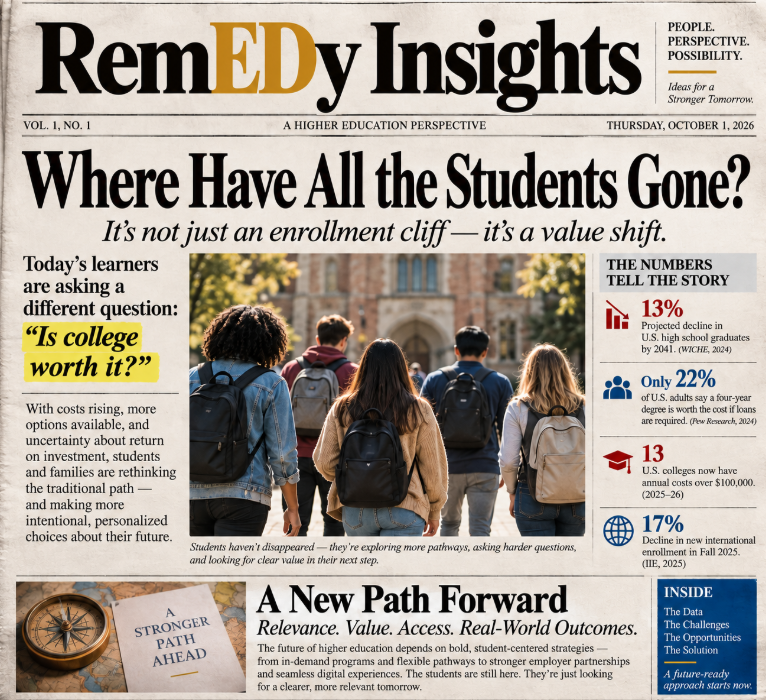
Where Have the Students Gone?
Higher education is not simply facing an enrollment problem. It is facing a value problem.
The question “Where have all the students gone?” is understandable—but it may be the wrong question.
The more important question is:
What changed in the way people decide whether higher education is worth their time, money, and risk—and what are institutions doing about it?
The demographic warning has been real. WICHE projects that the number of U.S. high school graduates peaked around 2025 and will decline through 2041, ultimately falling about 13% from the peak. That creates a structural constraint on the traditional 18-year-old enrollment pipeline. WICHE
But demographics are only part of the story.
The value equation has changed
For students and families, college is increasingly being evaluated through a much more practical lens:
What am I paying? What will I get? How long will it take? And what happens afterward?
That is not a rejection of higher education. It is a demand for greater clarity and evidence.
Pew Research found that only 22% of U.S. adults say a four-year degree is worth the cost if someone has to take out loans. Another 47% say it is worth the cost only if the student does not need loans. Among adults ages 18–29, 55% say a degree is worth the cost only if they do not have to borrow. Pew Research Center
Gallup and Lumina found a similar tension: only 18% of current and prospective college students surveyed believe four-year colleges charge fair prices for what they provide, while 59% disagree. Gallup.com
And the sticker price can be difficult for families to reconcile with the perceived return. In 2025–26, the average published tuition and fees were $11,950 for in-state students at public four-year institutions and $45,000 at private nonprofit four-year institutions. Average total student budgets reached $65,470 at private nonprofit four-year colleges. College Board Newsroom
At the extreme end, 13 private colleges had published annual costs above $100,000 for 2025–26. Importantly, that is sticker price, not necessarily what families actually pay after grants and scholarships—but the headline number still shapes perception. Road2College
That changes the conversation.
The prospective student is no longer comparing one college to another.
They are comparing college to everything else they could do with four years of their life and tens of thousands of dollars.
The competition is no longer just another institution
Students have more pathways than the traditional four-year model.
Some are entering the workforce earlier. Some are pursuing short-term credentials or technical education. Some are attending community colleges. Others are combining work, online education, certificates, and degrees.
And the data reflects that broader marketplace.
In spring 2025, undergraduate enrollment increased 3.5% nationally, with community colleges growing 5.4%—the largest increase among major institutional sectors. Yet undergraduate enrollment remained 2.4% below spring 2020 levels. Student Clearinghouse
That is an important distinction:
Students have not disappeared. They are making more differentiated choices.
COVID permanently changed the geography of competition
The pandemic accelerated online learning, remote work, digital student services, and expectations for flexibility.
Institutions that previously competed primarily within a geographic market suddenly found themselves competing for students beyond their traditional boundaries.
That created opportunity for institutions with strong online infrastructure and compelling academic offerings—but it also exposed institutions with limited digital capacity, weak marketing infrastructure, or insufficient resources to move quickly.
For smaller institutions operating with constrained budgets and lean teams, that imbalance can be particularly difficult.
International enrollment is another variable—but the story is evolving
International students remain a major component of U.S. higher education. In 2024–25, the U.S. hosted nearly 1.18 million international students, up 5% overall from the prior year. But new international enrollment fell 7%. IIE
The pressure became more pronounced in the following cycle. IIE's Fall 2025 Snapshot found a 17% decline in new international enrollment, while graduate international enrollment fell 12%. IIE
And by 2026, NAFSA was projecting that international enrollment could decline further, citing a combination of application declines, visa constraints, and policy changes. NAFSA
For institutions that historically depended heavily on international demand—particularly at the graduate level—that adds another layer of uncertainty.
Then there is financial aid
Federal student-aid policy is also changing.
Recent federal legislation and subsequent Department of Education rulemaking have altered aspects of Pell Grant eligibility, student borrowing, institutional accountability, and created a Workforce Pell pathway for certain short-term programs. FSA Partner Connect
The implication is not simply that funding is disappearing.
It is that the assumptions institutions have historically built around affordability, aid, program demand, and student financing are becoming less predictable.
That matters because institutions are being asked to make long-term academic and financial decisions in a market where student behavior is changing faster than many institutions can respond.
So what does an institution do?
This is where the conversation needs to move beyond:
“How do we get more students?”
and toward:
“How do we become more relevant to the students who are deciding whether we belong in their future?”
That requires more than adding another program or increasing advertising.
It requires an integrated approach to value, market distinction, access, experience, and execution.
Build programs around demonstrated demand
Academic strategy should start with the labor market, regional workforce needs, employer relationships, student behavior, and competitive gaps—not simply what the institution has historically offered. This is a hard pill for some institutions to swallow who have always pushed “we teach you for knowledge, you find your path”. While there is a place for this, it should be cloaked into a deeper framework around demand and value.
The question becomes:
What problem are we solving, for whom, and why is our institution uniquely positioned to solve it?
Make the value visible
Institutions often know their value better than their prospective students do.
Career outcomes. Time to completion. Transfer pathways. Internship opportunities. Employer partnerships. Earnings potential. Flexible delivery. Faculty expertise. Affordability.
These cannot live inside a catalog or buried webpage.
They have to become part of the institution's digital value proposition.
Personalize the path
A traditional prospective student, an adult learner, a transfer student, a first-generation student, and an employer-sponsored learner should not necessarily encounter the same institutional story.
Their motivations are different.
The digital experience should recognize that.
That means moving from a website that simply publishes information to one that helps different audiences understand relevance and take the next step.
Remove friction
Every confusing program page, outdated deadline, broken form, inaccessible experience, unclear tuition explanation, or generic call to action introduces another reason for a prospective student to leave.
Accessibility is part of this conversation. So are search visibility, mobile experience, content governance, speed, personalization, analytics, and clear calls to action.
These are no longer simply “website” issues.
They are enrollment infrastructure.
Design for the institution's capacity
The answer cannot always be “do more.”
Many institutions are already asking a small number of people to manage recruitment, marketing, communications, web governance, technology, and brand simultaneously.
A sustainable strategy has to account for the human infrastructure required to execute it.
That means governance, workflows, automation, centralized content management, usable data, and technology that allows institutions to make changes quickly without rebuilding the entire machine every time the market shifts.
The real opportunity
The institutions that navigate this environment successfully will not necessarily be the ones with the largest marketing budgets.
They will be the ones that can connect the dots:
Market demand → academic strategy → compelling value → personalized engagement → accessible digital experience → conversion → retention → sustainable economics.
Enrollment is the output.
Relevance is the strategy.
And that may be the most important shift happening in higher education right now.
The challenge is no longer simply filling seats.
It is building an institution that prospective students, families, working adults, employers, and communities can clearly understand, afford, access, and believe in.
That is a much bigger challenge.
But it is also a much more actionable one.
A strategic solution: the “Future-Ready Enrollment” framework
The goal is not to chase students. It is to build an institution whose value is easier to discover, understand, trust, and act upon.
That is where enrollment strategy, academic innovation, digital experience, personalization, accessibility, and institutional sustainability converge. And that is where I think the next generation of higher education strategy needs to go.